


Lumbar support maintains the natural inward curve of the lower spine, known as lumbar lordosis, by filling the gap between your lower back and a seat. Used correctly, it reduces mechanical strain on the L3–L5 region and supports active recovery. A 2020 Cochrane-style systematic review makes the key distinction clear: lumbar support works as an adjunct to exercise and therapy, not as a standalone cure.
Table of Contents
- What is lumbar support and how does it protect your lower spine?
- What types of lumbar support are available?
- What does the research actually say about effectiveness?
- How to position lumbar support correctly for daily use and recovery
- How to choose the right lumbar support for active recovery
- When lumbar support is not enough: signs you need clinical care
- Key Takeaways
- The part most guides skip about lumbar support
- Pair your lumbar support with targeted deep tissue recovery
- Useful sources
What is lumbar support and how does it protect your lower spine?
Your lumbar spine runs from L1 to L5, and it carries a natural inward curve called lordosis. When you sit without support, that curve tends to flatten or reverse, loading the discs and forcing the paraspinal muscles to compensate. Over time, that sustained load is what produces the familiar mid-afternoon ache.
Lumbar support works by pressing gently into the small of your back, preserving the lumbar curve and keeping the pelvis upright. That single mechanical action reduces disc pressure, limits excessive flexion, and allows the paraspinal muscles to relax rather than brace. Research confirms that lumbar supports can reduce paraspinal muscle activity and decrease lumbar muscle fatigue during sustained sitting.

The key word is gentle. Good support encourages a neutral posture. It does not force an exaggerated arch, and it does not replace the need for movement.
Key mechanical benefits:
- Fills the gap between the lower back and backrest, maintaining lordosis
- Keeps the pelvis tilted slightly forward, reducing slump
- Reduces sustained disc and muscle load during prolonged sitting
- Allows paraspinal muscles to relax, supporting functional recovery
Research note: A meta-analysis of randomized controlled trials found lumbar support produced statistically significant pain reduction in some low back pain populations, though heterogeneity among studies was high.
What types of lumbar support are available?
Lumbar supports range from thin foam pads to rigid orthoses. The right category depends on your activity, the level of stabilization you need, and whether you are managing acute pain, recovering post-workout, or simply sitting at a desk for eight hours.
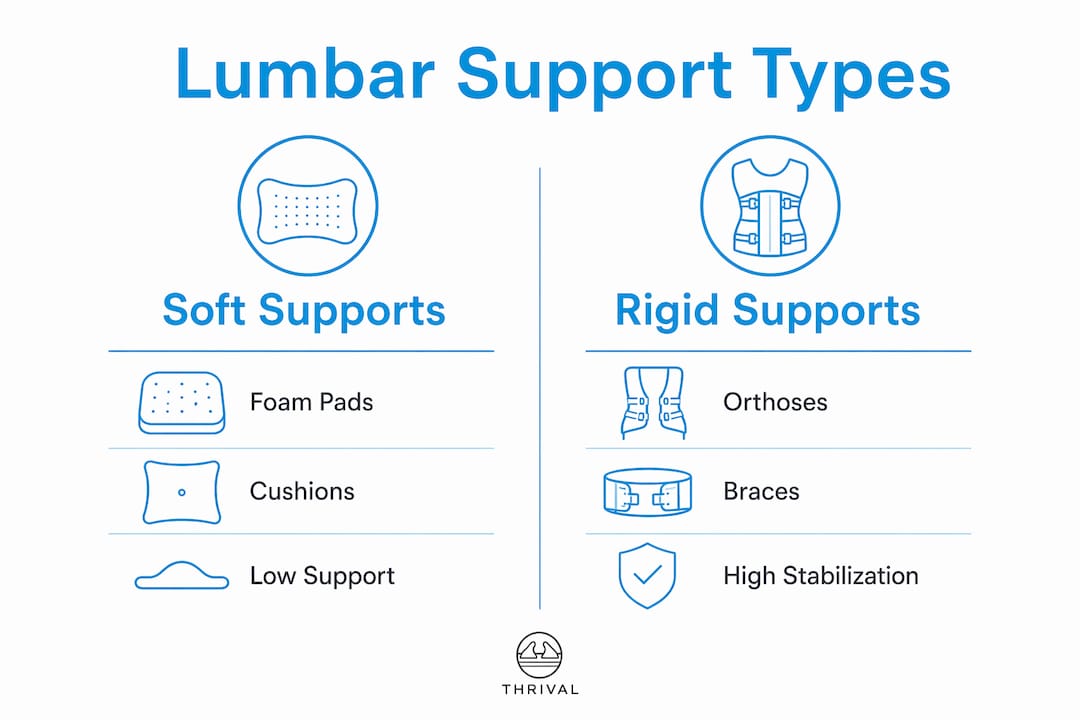
| Type | Stabilization level | Best use case | Main trade-off |
|---|---|---|---|
| Built-in chair support | Low to moderate | Daily desk work, adjustable chairs | Fixed depth; may not fit all spine shapes |
| Soft pad or roll | Low | Office, driving, light recovery | Portable and affordable; limited firmness |
| Inflatable cushion | Adjustable | Travel, driving, variable firmness needs | Can shift; requires periodic re-inflation |
| Semi-rigid orthosis | Moderate | Post-workout recovery, mild instability | Warmer to wear; some movement restriction |
| Rigid brace | High | Clinician-directed rehab, post-injury | Limits motion significantly; not for daily desk use |
| Decompression/recovery tool | Targeted | Post-exercise spinal release, muscle recovery | Requires active use; not passive seating support |
Lumbar supports come in soft, semi-rigid, and rigid varieties, each designed to correct posture, limit motion, or reduce mechanical loading to a different degree. An office worker benefits most from a soft pad or an adjustable built-in mechanism. A driver on a long haul often does better with an inflatable cushion they can tune on the go. After intense training, a semi-rigid recovery tool that targets the L3–L5 region directly addresses muscle fatigue rather than just filling a gap in a chair.
What does the research actually say about effectiveness?
The evidence is genuinely useful, but it comes with important nuance. A meta-analysis of RCTs found statistically significant pain reduction in some low back pain populations when lumbar supports were used, though heterogeneity across studies was high. That means results varied considerably depending on population, usage pattern, and whether support was combined with active therapy.
“There is moderate evidence that lumbar supports are not more effective than no intervention or training for primary prevention of low back pain.” — PMC7046130
The distinction between prevention and treatment matters. For people already experiencing low back pain, lumbar support used alongside structured exercise or physical therapy tends to produce better outcomes than passive use alone. As a tool to prevent a first episode of low back pain at a population level, the evidence is weaker.
The clinical takeaway: lumbar support is a solid adjunct for symptomatic relief and recovery support. It is not a reliable standalone preventive measure.
How to position lumbar support correctly for daily use and recovery
Placement is where most people go wrong. A support set too high sits on the mid-back; too low, it presses on the tailbone. Neither position maintains lordosis, and both tend to feel uncomfortable within minutes.
- Find your belt line. Place your hands on the top of your hips. The support should sit one to two fingers above that level, targeting the L3–L5 region.
- Sit fully back. Push your hips all the way to the back of the seat before adjusting the support height. If you sit on the edge, the support loses contact with the target area.
- Check the contact. You should feel gentle, even pressure in the small of your back, not a hard push that drives your torso forward.
- Set straps snugly, not tight. Straps should hold the device in place without compressing it against the chair frame, which collapses the contour and reduces effectiveness.
- Run a 30-minute validation test. Early discomfort often takes 15–20 minutes to appear. Sit through a normal task, typing or driving, and check for pressure points, posture drift, or shoulder tension.
Dos and don’ts: Take movement breaks every 30–45 minutes regardless of how well the support fits. Pair lumbar support with ergonomic workstation setup for the best results. Do not use the support as a reason to skip strengthening work.
Pro Tip: Firm enough to hold the curve is the target. If the support feels cushiony and soft, it is likely compressing under load and no longer maintaining lordosis. Start with a firmer profile and reduce depth only if it pushes your torso noticeably forward.
How to choose the right lumbar support for active recovery
Match the category to your primary use case first. A soft pad works for daily desk sitting. A semi-rigid orthosis suits post-workout recovery or mild instability. A clinician-prescribed rigid brace is appropriate only when directed.
From there, check these criteria:
- Adjustability: Height and depth adjustment lets you dial in contact with the L3–L5 curve as your posture shifts through the day.
- Firmness: Firm enough to hold shape under load. A support that compresses flat within an hour provides no structural benefit.
- Breathability: Mesh or ventilated materials matter for post-workout use when heat and moisture are factors.
- Strap or attachment method: Secure enough to stay in place during movement without overtightening.
- Compatibility: Confirm it fits your chair’s backrest profile before buying.
Red flags to avoid: any product that forces your torso forward, any support that sits at mid-back or tailbone level, and anything marketed as a cure-all for structural back conditions. Some conditions require clinician prescription. When in doubt, get a professional assessment before selecting a device. Check manufacturer credentials including FDA registration, warranty terms, and usage instructions before purchasing.
When lumbar support is not enough: signs you need clinical care
Lumbar support addresses mechanical strain during sitting and recovery. It cannot resolve neurological symptoms, structural pathology, or progressive conditions.
Seek immediate medical attention for any of these:
- Progressive leg weakness or sudden loss of strength
- Numbness, tingling, or altered sensation radiating into the legs or feet
- Bladder or bowel changes alongside back pain
- Pain that radiates below the knee and does not improve with position changes
- Worsening pain despite correct support use over several days
For persistent or worsening pain without neurological signs, a primary care visit or physical therapy referral is the right next step. Imaging is appropriate only when clinically indicated, not as a first response to back discomfort. Lumbar support is an adjunct to diagnosis and therapy, not a substitute for either.
This article is general information, not medical advice. Confirm your situation with a qualified clinician or primary care provider.
Key Takeaways
Lumbar support maintains lumbar lordosis at the L3–L5 region, reduces paraspinal muscle load, and aids recovery when used correctly alongside active therapy and movement.
| Point | Details |
|---|---|
| Definition and target | Lumbar support fills the gap between your lower back and seat to maintain the natural inward curve at L3–L5. |
| Primary benefit | Reduces disc and paraspinal muscle load during sitting; research shows statistically significant pain reduction in some populations. |
| Correct placement | Position at belt line, sit fully back, and confirm gentle even contact in the small of your back. |
| Key limitation | Effective as an adjunct to exercise and therapy; not a standalone cure or reliable primary prevention tool. |
| Thrival recovery pairing | The Thrival Deep Tissue Pro targets the same spinal region with non-motorized deep tissue release, complementing passive lumbar support with active muscle recovery. |
The part most guides skip about lumbar support
The conversation around lumbar support tends to focus almost entirely on the passive side: buy the right cushion, place it correctly, and your back will feel better. That framing is incomplete, and it sets people up for disappointment.
The research is clear that lumbar support works best when it is part of a broader recovery strategy. Passive support during sitting reduces load. But the muscles around the lumbar spine still need active work to maintain strength, coordination, and resilience. A support that carries your posture all day without any complementary movement or strengthening can quietly reduce the demand on those muscles, which is the opposite of recovery.
The readers who get the most out of lumbar support are the ones who treat it as a tool, not a solution. They use it during long sitting sessions or post-workout recovery windows, pair it with back health routines and movement breaks, and understand that mild discomfort in the first few days of use is often postural muscles re-training, not a sign the support is wrong. That transition period is normal. Gradual adoption and active recovery alongside the support is what produces lasting results.
Pair your lumbar support with targeted deep tissue recovery
Lumbar support handles the passive side of spinal care. For the active side, the Thrival Deep Tissue Pro gives you targeted muscle release at the same L3–L5 region where lumbar supports work.
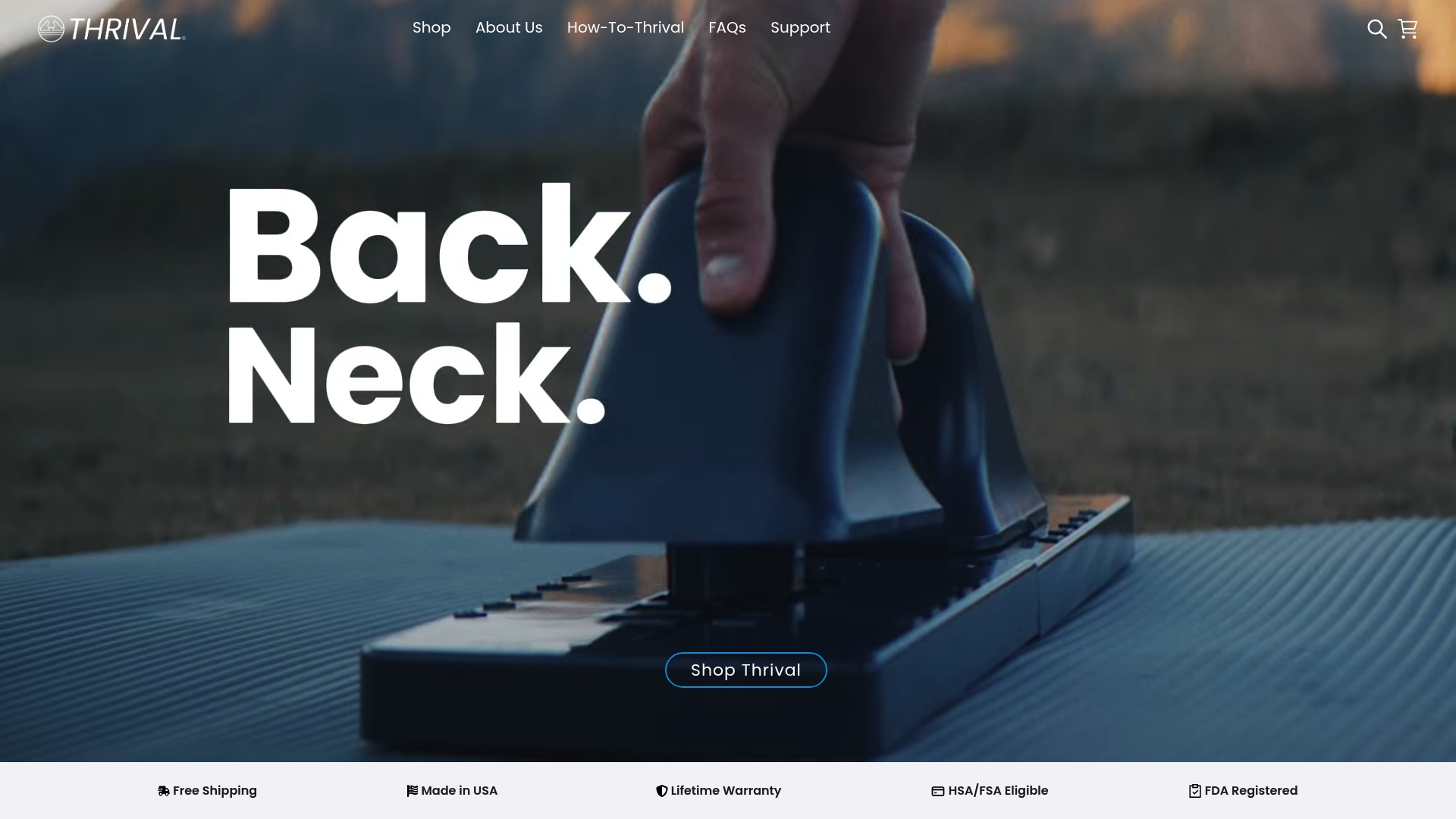
The Thrival system is a non-motorized base board with interchangeable attachments, including the Arch and Ballhead, designed for spinal decompression and deep tissue release across the back, hips, and shoulders. No motor, no subscription, just a durable, US-manufactured tool built for athletes, desk workers, and anyone pairing passive support with active recovery. It carries FDA registration and a lifetime warranty. Free shipping is included on every order.
Active people who spend long hours sitting or training hard get the most from combining a well-fitted lumbar support with a post-session deep tissue routine. Visit the Thrival Deep Tissue Pro page to see the full attachment system and find the right configuration for your recovery needs.
Useful sources
| Source | Type | Link |
|---|---|---|
| PMC meta-analysis: lumbar support and pain reduction (RCT review) | Clinical meta-analysis | View source |
| PMC7046130: Cochrane-style systematic review on lumbar supports | Systematic review | View source |
| ERGOLA: how to position lumbar support | Ergonomics guidance | View source |
| Ergonomic Zone: does lumbar support help lower back pain? | Practical ergonomics | View source |
| Parks Therapy Centre: ergonomics and injury prevention | Clinical ergonomics | View source |
| Thrival: spinal health and recovery resources | Brand resource | View source |