


Stretching after your workout feels productive, and foam rolling has its place in any recovery routine. But if you think those two habits alone are enough to keep your muscles performing at their best, research suggests otherwise. Percussion massage outperformed stretching in a controlled trial measuring recovery in young men, and massage ranked highest for biochemical recovery markers like CK and IL-6. Sports massage therapy offers a level of targeted muscle relief that passive stretching simply cannot match. This guide covers what it is, how it works, which techniques matter, when to use it, and what to watch out for.
Table of Contents
- What is sports massage therapy?
- The main techniques and tools used
- When and why to use sports massage
- Risks, contraindications, and expert best practices
- The real role of sports massage in athletic recovery
- Integrate effective recovery tools into your routine
- Frequently asked questions
Key Takeaways
| Point | Details |
|---|---|
| Targeted manual therapy | Sports massage uses specialized techniques to support athletic performance and recovery. |
| Variety of techniques | Effleurage, deep tissue, trigger point therapy, and tools each serve specific recovery roles. |
| Optimal timing matters | Pre-event, post-event, and ongoing maintenance sessions maximize benefits. |
| Know the risks | Contraindications exist, so safety and personalization are essential for all users. |
| Best as part of a plan | Sports massage is most effective when integrated into a holistic recovery strategy, not as a standalone solution. |
What is sports massage therapy?
Sports massage therapy is not just a relaxed rubdown with athletic branding. It is a targeted, evidence-based form of manual therapy built around the specific physical demands of athletic training and competition.
Sports massage therapy is a specialized form of manual therapy designed for athletes and active individuals to enhance performance, speed recovery, prevent injuries, and aid rehabilitation by targeting muscles, tendons, ligaments, and fascia. That last word, fascia, refers to the connective tissue that wraps around every muscle in your body. When it tightens or develops adhesions, your movement quality drops.
What separates sports massage from a standard relaxation massage is its clinical focus. A therapist using sports massage is thinking about your training schedule, the muscles you loaded hardest, and where you might develop compensations. The work is purposeful. Every stroke has a reason.
Key features that define sports massage therapy:
- Tissue-specific targeting: The therapist focuses on muscles, tendons, and fascia directly involved in your sport or activity
- Technique variety: Multiple methods are combined in a single session based on your condition and goals
- Timing-sensitive application: The same technique used before competition serves a different purpose than the same technique used 48 hours after a hard training block
- Injury prevention focus: Regular maintenance work identifies and releases tension before it becomes a structural problem
- Performance support: Improved mobility and recovery benefits translate directly to training quality
“Sports massage is not a luxury—it’s a tool. When applied correctly and at the right time, it addresses the physical toll of training in ways that passive recovery methods cannot replicate.” — leading sports physiotherapy consensus
Understanding the range of available soft tissue therapy types helps you ask the right questions and communicate more clearly with your therapist or choose the right self-massage tool for your needs.
The main techniques and tools used
Sports massage is not a single technique. It is a collection of methods, each with a specific purpose and ideal application window. A skilled therapist selects from this toolkit based on where you are in your training cycle and what your tissue actually needs.
Core sports massage techniques include effleurage (gliding strokes for warming up and circulation), petrissage (kneading for mobilization), deep tissue massage, myofascial release (sustained pressure on fascia), trigger point therapy (focused pressure on knots), tapotement (percussion for stimulation), and tools like massage guns for vibration and cupping. Here is how they compare in practice:
| Technique | Goal | Typical use case |
|---|---|---|
| Effleurage | Warm tissue, increase circulation | Session opener, pre-event |
| Petrissage | Mobilize muscle fibers, reduce tension | Mid-session general work |
| Deep tissue massage | Release chronic tension in deeper layers | Maintenance and rehabilitation |
| Myofascial release | Restore fascial mobility | Chronic tightness, post-injury |
| Trigger point therapy | Deactivate specific muscle knots | Persistent localized pain |
| Tapotement | Stimulate and activate muscle tone | Pre-event warm-up |
| Percussion tools | Vibration-based tissue stimulation | Post-session, between sessions |
| Cupping | Decompress tissue layers | Chronic tightness, scar tissue |
A typical sports massage session follows a clear sequence:
- Assessment: The therapist reviews your training load, pain points, and goals before touching you
- Warm-up strokes (effleurage): Light gliding movements increase blood flow and prepare tissue for deeper work
- Tissue mobilization (petrissage): Kneading strokes break up surface-level tension and improve circulation in specific muscle groups
- Targeted deep work: Deep tissue techniques address chronic holding patterns or post-training soreness in specific areas
- Trigger point treatment: Focused sustained pressure on identified knots; your therapist may use elbow, knuckle, or a specialized tool
- Myofascial release: Slow, sustained holds on fascial layers to restore length and reduce restrictions
- Flush and cool-down: Return to lighter effleurage strokes to encourage lymphatic drainage and signal the nervous system to relax
Pro Tip: Use percussion tools and vibration devices between professional sessions to maintain tissue quality, but save deeper trigger point work for after your most intense training days, not before. Aggressive trigger point release immediately before a competition can temporarily reduce force output.
Choosing the right muscle recovery tools for home use depends on your target areas. Ballhead-style attachments mimic the focused pressure of thumb or elbow work, while wave or arch attachments distribute pressure across broader muscle surfaces like the thoracic spine or glutes.
When and why to use sports massage
Timing matters more in sports massage than most athletes realize. The same pressure applied to the same muscle can either prime it for performance or set back your recovery, depending on when it happens.
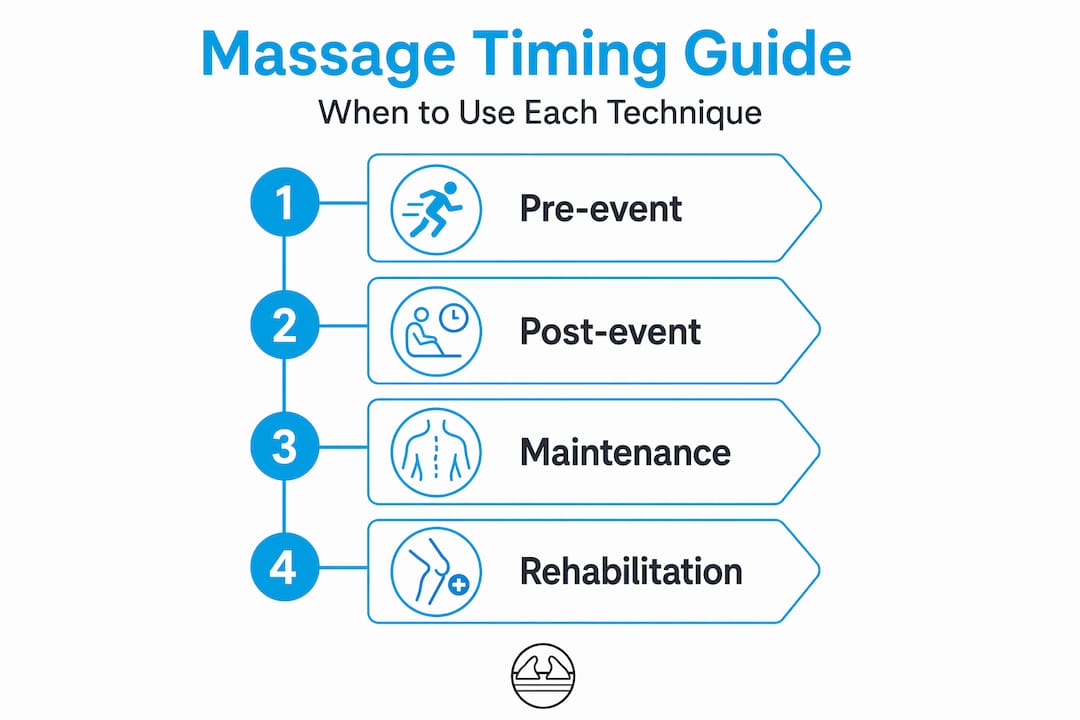
Sports massage timing breaks down into four types: pre-event (light techniques to prime muscles, 15 to 30 minutes), post-event (deeper work to reduce DOMS within 2 hours), maintenance (regular sessions for ongoing tension release), and rehabilitative (targeted work during injury recovery).
| Type | Purpose | Timing | Key technique |
|---|---|---|---|
| Pre-event | Activate and prime muscles | 15 to 45 min before activity | Effleurage, tapotement |
| Post-event | Reduce soreness, flush metabolites | Within 2 hours after activity | Light petrissage, effleurage |
| Maintenance | Prevent buildup, improve mobility | Every 1 to 4 weeks during training | Deep tissue, myofascial release |
| Rehabilitative | Support injury recovery | Ongoing during rehabilitation | Trigger point, myofascial, light tissue work |
The research on outcomes is strong. Massage reduces DOMS, improves flexibility and range of motion, and lowers biochemical markers of muscle damage including creatine kinase (CK), interleukin-6 (IL-6), and calcium ions. These are measurable changes in the body, not just subjective feelings of relief.
Proven benefits backed by current evidence:
- Delayed onset muscle soreness (DOMS) reduction: Post-event massage significantly lowers perceived soreness 24 to 72 hours after exercise
- Improved range of motion (ROM): Regular sessions increase joint mobility and tissue extensibility over time
- Lower inflammatory markers: Massage reduces CK and IL-6, two key indicators of muscle damage and systemic inflammation
- Faster perceived recovery: 82% of athletes report faster recovery following regular massage therapy, according to AMTA data
- Performance-adjacent gains: A 2025 RCT found deep tissue massage improved flexibility and performance markers most significantly in team sport and strength athletes
It is worth noting that sports massage works best as an adjunct, meaning it supports your training rather than replacing other recovery strategies. When you combine it with quality sleep, hydration, and smart programming, the benefits of soft tissue release compound over time.
Active individuals who integrate maintenance massage every two to three weeks during peak training blocks tend to report fewer overuse injuries and more consistent training output. That is not coincidence. Regular tissue work keeps small restrictions from becoming chronic problems. Building this into your muscle recovery strategies is one of the simplest ways to extend your training longevity.
Risks, contraindications, and expert best practices
Understanding when not to use sports massage is just as important as knowing when it helps. Applying the wrong technique at the wrong time on compromised tissue can make an injury significantly worse.
Absolute contraindications (conditions where massage should not be performed at all) include open wounds, active infections, acute injuries such as muscle ruptures or fractures, deep vein thrombosis (DVT) or blood clots, fever, contagious conditions, and recent stroke. Relative contraindications (conditions requiring modified pressure or medical clearance) include pregnancy, active cancer, osteoporosis (low bone density), and anticoagulant therapy (blood thinners that increase bruising risk).
Additional red flags and common mistakes to avoid:
- Massaging acutely inflamed tissue: Applying deep pressure within the first 24 to 48 hours of a new injury increases local inflammation and delays healing
- Skipping the assessment: Jumping straight into deep work without knowing the athlete’s history increases risk of aggravating existing conditions
- Ignoring pain signals during a session: Moderate discomfort from pressure on a trigger point is normal; sharp, radiating, or worsening pain is a stop signal
- Excessive intensity after detraining: Athletes returning from a break have more sensitive tissue; pressure needs to be dialed back significantly
- Using percussion tools on bony areas: Vibration tools are for soft tissue only; using them directly on joints, spine, or bony prominences can cause bruising or nerve irritation
- Treating symptoms without addressing cause: Repeated trigger point work on the same spot without looking at movement patterns or load management is a temporary fix only
Pro Tip: Before every session, rate your fatigue, soreness, and any localized pain on a simple 1 to 10 scale. Share that with your therapist or use it to guide your self-massage intensity at home. If your soreness score is above 7, lighter targeted muscle therapy is more appropriate than aggressive deep tissue work. This kind of feedback loop makes your recovery smarter over time.
If you want to build a solid foundation for safe, effective manual therapy at home, reviewing the existing therapeutic massage evidence helps you set realistic expectations and choose techniques that match your current recovery state.
The real role of sports massage in athletic recovery
Here is what most people get wrong: they treat sports massage as either a miracle fix or a reward for training hard. Neither framing serves you well.
Sports massage is a powerful support tool. It does not directly boost your VO2 max, increase strength, or replace the adaptation that comes from actual training. Sports massage supports performance indirectly, through better range of motion, reduced soreness, and improved tissue quality. The performance gains come from being able to train consistently at a higher quality, not from the massage itself.
The athletes who benefit most from regular massage therapy are not the ones who get a session after every hard workout. They are the ones who build it strategically into a full recovery system. That means pairing massage with adequate sleep (seven to nine hours for most athletes), appropriate nutrition timing, mobility work, and load management.
Avoid deep work immediately post-event on inflamed tissue. Percussive tools amplify recovery effects but are contraindicated on fresh injuries. Tailoring technique to sport-specific needs and ongoing athlete feedback is what separates effective recovery from wasted effort. A distance runner’s glutes and hip flexors need different treatment than a baseball pitcher’s rotator cuff.
The uncomfortable truth for high-achievers: more is not better. Over-scheduling deep tissue work can leave your nervous system sensitized and your muscles more reactive, not less. A well-timed 20-minute session with the right attachment and focused pressure often outperforms a 90-minute full-body session done without clear purpose. Build in recovery from your recovery. Use lighter trigger point therapy on the days between hard sessions, and save the deeper work for true rest days when your body can respond and adapt.
Integrate effective recovery tools into your routine
Sports massage therapy works. The research is clear, the techniques are proven, and the timing protocols are well-defined. The next question is how you make this accessible on a daily basis, between professional appointments and around a real training schedule.
Thrival’s recovery system is built for exactly this. The Deep Tissue Pro tool gives you a non-motorized, US-manufactured platform that lets you apply targeted manual therapy at home with professional-level precision. Swap in the ballhead attachments for focused trigger point work on the glutes, shoulders, and upper back, or use other attachment options for broader fascial release along the spine and hips. The adjustable psoas release tool supports targeted hip flexor and lumbar work that most recovery tools simply cannot reach. Each attachment is FDA-registered and backed by a lifetime warranty, so you invest once and recover better for years.
Frequently asked questions
What is the difference between sports massage and deep tissue massage?
Sports massage is tailored to athletic needs and uses several techniques across a session, including but not limited to deep tissue methods, while deep tissue massage specifically targets deeper muscle layers and can be one component within a broader sports massage protocol.
How soon after exercise should I get a sports massage?
Post-event massage is most effective within 2 hours after exercise to reduce delayed onset muscle soreness and help clear metabolic waste from worked tissue.
Can sports massage therapy help prevent injuries?
Regular sports massage releases accumulated muscle tension and improves flexibility, and when combined with proper training load management, it can meaningfully lower the risk of overuse injuries over time.
Who should not get a sports massage?
Anyone with open wounds, acute injuries, fever, or blood clots should avoid sports massage entirely; those with relative contraindications like pregnancy or osteoporosis should consult a healthcare provider before proceeding.
Does sports massage therapy really enhance athletic performance?
Sports massage supports performance indirectly by improving range of motion and reducing soreness, which allows higher-quality, more consistent training rather than directly increasing strength or aerobic capacity.