


Most people assume stretching works by physically loosening a knot in the muscle, the way you might untangle a piece of rope. That mental picture is intuitive, but it misses most of the story. The real reasons stretching relieves physical tension involve your nervous system, specialized sensory organs inside your tendons, and the way your brain processes mechanical feedback from soft tissue. Understanding these mechanisms is not just interesting science; it is the difference between stretching effectively and wasting time on routines that barely move the needle on chronic tightness.
Table of Contents
- The science of tension: What is happening in your muscles?
- How stretching changes tension: Neural and mechanical mechanisms
- Stretching, pain, and recovery: What the evidence really shows
- Optimizing stretching for relief: Evidence-based tips and protocols
- Stretching for tension: What most guides miss (and what actually works)
- Relieve tension with expert tools and resources
- Frequently asked questions
Key Takeaways
| Point | Details |
|---|---|
| Mechanisms matter | Stretching relieves tension through neural relaxation and reduced muscle stiffness. |
| Pain vs. tension | Tension relief from stretching doesn’t always equal pain relief, especially after exercise. |
| Protocol counts | Optimal results require the right frequency, duration, and pairing with other methods. |
| Chronic gains | Long-term stretching builds greater stretch tolerance and reduced muscle stiffness. |
| Individual response | People’s relief from stretching depends on context, personal sensitivity, and technique. |
The science of tension: What is happening in your muscles?
Now that we have challenged the surface-level myth, let us break down what is really going on inside your muscles when you feel tense.
Muscle tension, stiffness, and pain are related, but they are not the same thing. Tension refers to the active or passive resistance a muscle produces, often driven by elevated neural activity. Stiffness is the mechanical property of the muscle-tendon unit, describing how much force is required to lengthen the tissue a given amount. Pain is a subjective experience that can accompany tension or stiffness, but it can also exist independently. Knowing the difference helps you choose the right intervention.
Your nervous system plays the central role in regulating how tight a muscle feels moment to moment. Motor neurons send signals to muscle fibers to contract, and the degree of that contraction determines resting tension. Embedded inside your tendons are Golgi tendon organs, or GTOs. These sensors measure force. When force rises to a sufficient level, GTOs trigger inhibitory feedback that reduces motor neuron excitability, helping the muscle relax. This is called autogenic inhibition, and it is one of the primary neural pathways stretching can tap into.
Common situations that drive elevated muscle tension include:
- Sitting at a desk for long periods with your hips flexed and shoulders rounded
- Training with high volume and insufficient recovery time
- Emotional stress, which elevates baseline neural drive to postural muscles
- Sleeping in positions that keep one muscle group in a shortened state for hours
- Returning to activity after a period of deconditioning
To understand why this feedback loop matters, consider what happens when the system stays activated too long. Sustained neural drive leads to prolonged contraction, reduced blood flow, and accumulated metabolites that register as that familiar “tight” feeling. Addressing the neural side of the equation, not just the tissue, is where effective stretching starts.
“Increasing muscle-tendon tension activates Golgi tendon organs, which trigger inhibitory feedback that reduces motoneuron excitability, helping the muscle relax.” This feedback loop is the biological foundation for why a well-executed stretch produces noticeable relief, not just a mechanical change.
Exploring common muscle tension causes in your daily life makes it easier to target your stretching where it will have the most impact.
How stretching changes tension: Neural and mechanical mechanisms
Having unpacked muscle tension, let us see exactly how stretching creates change, starting with the body’s built-in mechanisms.
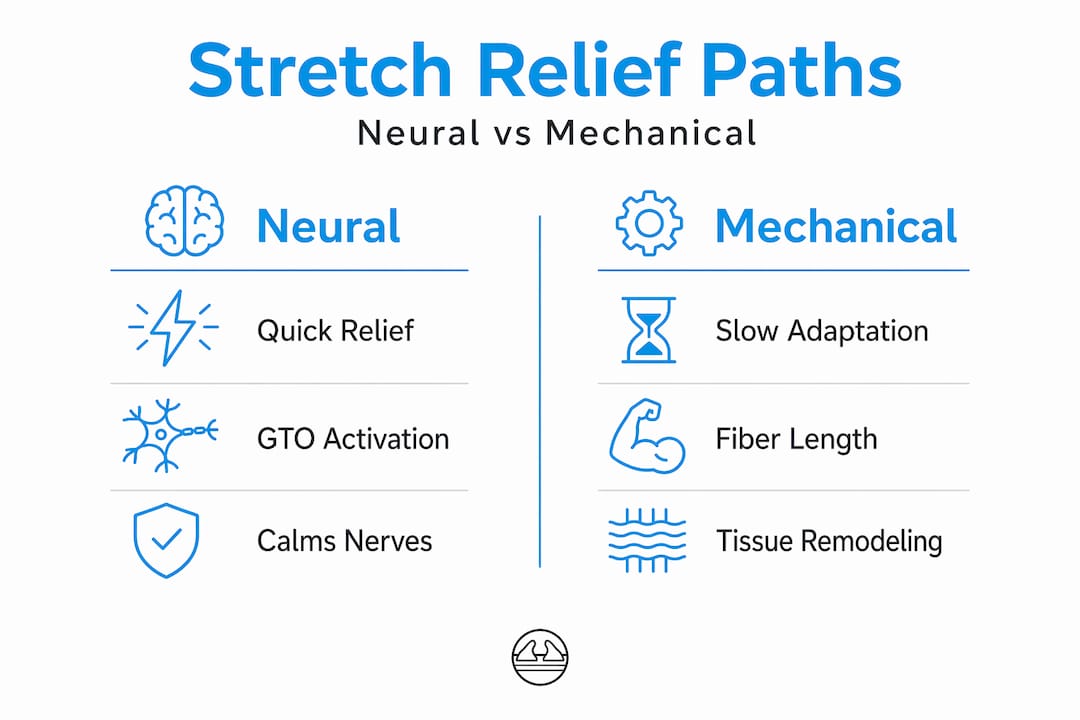
Stretching produces relief through two distinct but overlapping pathways. The first is neural: a well-held stretch builds force at the muscle-tendon junction, activating GTOs, which then send inhibitory signals back to the spinal cord to reduce motor neuron firing. The practical result is that the muscle literally receives fewer “contract” signals during and immediately after the stretch. The second pathway is mechanical: repeated and sustained stretching over time reduces overall tissue stiffness and raises the maximum force load you can tolerate before discomfort appears.

The table below summarizes how these two pathways differ in timing and magnitude based on current research.
| Stretching type | Primary mechanism | Tension relief timing | Stiffness reduction | Stretch tolerance |
|---|---|---|---|---|
| Acute static stretch | Neural (GTO, autogenic inhibition) | During and immediately after stretch | Moderate, short-lived | Mild acute increase |
| Chronic static stretching | Mechanical plus neural | Cumulative, over weeks | Significant reduction in stiffness | Marked improvement |
| PNF stretching | Neural (reflex facilitation) | Rapid onset, short duration | Moderate | Moderate |
| Dynamic stretching | Neural (reciprocal inhibition) | During movement, fades quickly | Low | Low to moderate |
Here is a numbered breakdown of what happens step by step when you perform a typical held static stretch:
- You lengthen the muscle to the point of mild tension and hold.
- Force builds progressively in the tendon as the muscle resists lengthening.
- GTOs detect the rising force and fire inhibitory signals toward spinal motor neurons.
- Motor neuron excitability drops, reducing the muscle’s active contraction signal.
- The muscle partially releases, and the subjective feeling of tightness decreases.
- Over repeated sessions, the connective tissue also adapts, reducing passive stiffness and raising tolerable stretch load.
For strategies that translate these mechanisms directly into your day, the guide to easing muscle tension provides structured, step-by-step approaches. If you want to understand the tissue-level science in even more depth, the breakdown of muscle knot relief science is worth reading alongside this article.
Pro Tip: Stretching at an intensity where you feel clear tension but no sharp pain places the optimal load on your GTOs. Undershooting the intensity means the GTO threshold may not be reached; overshooting it activates the muscle spindle stretch reflex, which counters relaxation by signaling the muscle to contract.
Stretching, pain, and recovery: What the evidence really shows
With the basic mechanisms clear, it is crucial to separate myth from science around stretching’s actual impact on pain, soreness, and long-term relief.
One of the most common misconceptions is that stretching and pain relief are interchangeable outcomes. They are not. Stretching reliably reduces the subjective perception of tension and can lower stiffness, but its relationship to pain is more conditional. Stretching programs over 4 to 6 months show meaningful reductions in pain scores in musculoskeletal pain populations across some studies, though results are not uniform. Context matters enormously.
The comparison below shows where chronic stretching tends to deliver results versus where it falls short.
| Outcome | Chronic stretching program | Post-exercise stretching only |
|---|---|---|
| Resting muscle tension | Consistent reduction | Minimal change |
| Perceived pain (chronic MSK conditions) | Moderate benefit in many cases | Limited and inconsistent |
| Delayed onset muscle soreness (DOMS) | Not a primary remedy | No significant improvement vs. no stretching |
| Passive stiffness | Significant long-term reduction | Transient, acute reduction only |
| Stretch tolerance | Marked improvement over weeks | Minimal acute change |
Research on post-exercise soreness is particularly clear: a meta-analysis found no statistically significant improvements in soreness, flexibility, pain threshold, or performance when post-exercise stretching was compared to no stretching. That does not mean stretching after a workout is useless. It means you should not expect it to be the primary tool for DOMS management.
Stretching is most likely to help your pain or discomfort when:
- The discomfort is related to resting tension from sedentary postures or overuse
- You apply it consistently as part of a multi-week program rather than one-off sessions
- The muscle group is genuinely shortened or restricted in range of motion
- You pair it with movement, load management, or targeted muscle therapy
Stretching is less likely to help when:
- Pain is driven by sensitization or a neurological process rather than mechanical tightness
- You are in the acute phase of a muscle or tendon injury
- The underlying problem is joint-level rather than soft tissue
- You use it in isolation without addressing contributing lifestyle or movement factors
The practical takeaway here is that stretching is a powerful tool within a broader toolkit, not a standalone solution for every type of discomfort.
Optimizing stretching for relief: Evidence-based tips and protocols
Knowing how stretching actually works sets the foundation, but using it effectively requires attention to protocol and practical habits.
Stretching protocols and dosage matter significantly for the mechanical and range-of-motion adaptations you are working toward. Research highlights neural contributors like stress relaxation and autogenic inhibition via GTOs, but it also notes that details such as GTO activation timing in proprioceptive neuromuscular facilitation (PNF) techniques are still being refined. What is clear is that intensity, duration, and frequency each play a distinct role.
Follow these steps to optimize your stretching outcomes:
- Match intensity to purpose. Aim for 5 to 7 out of 10 perceived tension during each stretch. This range reliably engages the GTO pathway without triggering protective reflexes that oppose relaxation.
- Hold long enough to matter. Evidence supports holding static stretches for 30 to 60 seconds per set for meaningful neural and early mechanical response. Shorter holds of 10 to 15 seconds are below the threshold for sustained GTO activation.
- Accumulate weekly volume. A total of 5 to 10 minutes of stretching per muscle group per week appears to be the minimum effective dose for chronic stiffness reduction. Spreading that across three or more sessions is more effective than doing it all in one.
- Prioritize consistency over intensity. Stretching every day at moderate intensity produces better long-term results than aggressive weekly sessions. The tissue and neural adaptations are gradual and cumulative.
- Match your protocol to your goal. Athletes managing performance-related tension may benefit from dynamic and PNF methods before and after training. Desk workers dealing with postural tightness typically see the best results from daily static stretching targeting the hip flexors, thoracic spine, and posterior shoulder chain.
For targeted work on the hips, one of the most chronically tight areas in sedentary and active populations alike, the article on hip flexibility protocols outlines specific routines worth integrating. When stretching alone is not delivering relief, pairing it with soft tissue therapy types adds a complementary mechanical layer that stretching cannot replicate on its own.
What to avoid:
- Chronic overstretching past the point of discomfort, which can cause micro-damage rather than relief
- Holding your breath during stretches, which increases neural tension and reduces the relaxation response
- Ignoring persistent pain signals and pushing through them, which may worsen underlying problems
Pro Tip: Pairing stretching with light active movement immediately afterward, like gentle walking or controlled joint circles, takes advantage of the temporary reduction in neural drive and helps solidify the new range of motion your body just accessed. This combination is especially effective for athletes and anyone managing recurring tension patterns.
Stretching for tension: What most guides miss (and what actually works)
Even with well-documented protocols at hand, most stretching guides treat relief as a purely mechanical problem. They focus on angles, hold times, and muscle groups, and while that information is useful, it leaves out a significant piece of the puzzle.
The uncomfortable truth is that chronic tension is rarely just about tight tissue. Neural tension, stress, habitual posture, breath patterns, and psychological state all influence your baseline muscle tone in ways that no stretch can fully address. When someone holds chronic tension in their upper traps or lower back for years, the driver is often as much behavioral and neurological as it is mechanical. Listening to your body’s signals means treating that tension as information, not just a mechanical problem to fix.
“Stretch tolerance” is a term that appears often in the research, and it is worth examining closely. What it actually measures is how much pulling sensation you can endure before you stop or reposition. That measure reflects your nervous system’s threat assessment as much as it reflects tissue compliance. When chronic stretching improves stretch tolerance over weeks, part of what is changing is your neural sensitivity and your brain’s willingness to allow range, not just the physical length of your muscle fibers. That is encouraging because it means even people with long-standing tightness can retrain the response, but it also means the work needs to be consistent and patient.
What actually produces lasting tension relief, based on outcomes rather than theory alone, is a combination of regular stretching, progressive strength work through a full range of motion, intentional movement patterns that break up prolonged static postures, and periodic manual or tool-based soft tissue work to address tight spots that stretching alone cannot fully access. The people who see the most durable improvement are those who treat tension relief as an ongoing practice rather than an acute fix.
Experiment with your protocols. Track what helps. Adjust based on your results, not just what a single study recommends. The science gives you a framework; your body gives you the feedback.
Relieve tension with expert tools and resources
Stretching is a powerful foundation for tension relief, but adding specialized recovery tools takes your results further. For muscle groups that remain persistently tight despite regular stretching, targeted deep tissue work can reach areas that passive stretching cannot effectively address.

The Thrival deep tissue recovery tool delivers focused pressure precisely where you need it, complementing the neural relaxation that stretching initiates. For varied muscle groups and body areas, wave attachments allow you to customize pressure and coverage based on your specific tension patterns. Whether you are dealing with recurring back tightness, hip stiffness, or shoulder tension, Thrival’s full range of recovery solutions is built to support an integrated approach to muscle relief, combining the science of stretching with professional-grade tools designed for real daily use.
Frequently asked questions
Does stretching help with all types of muscle tension?
Stretching relieves most common tension driven by neural overactivity or postural shortening, but cases involving pain sensitization, injury, or soreness from intense exercise may require more comprehensive approaches. Post-exercise soreness in particular often does not respond to stretching alone, and broader rehab strategies tend to be more effective.
How long does it take to feel reduced tension from regular stretching?
Many people notice immediate relief from the neural relaxation effect during and after a single session. Greater mechanical benefits, including significant stiffness reduction and improved stretch tolerance, typically develop over several weeks of consistent practice.
Is stretching alone enough to recover from post-workout soreness?
No. Research clearly shows that stretching by itself does not produce statistically significant improvements in delayed onset muscle soreness, pain threshold, or performance compared to no stretching. Active recovery, nutrition, sleep, and soft tissue work contribute more meaningfully.
Should I feel pain while stretching to get tension relief?
No. Effective stretching produces a clear pulling sensation, typically a 5 to 7 out of 10 on a subjective tension scale, but not sharp or intense pain. Pushing into pain can trigger protective muscle contraction and worsen discomfort rather than relieve it.
What’s the most important type of stretching for relieving tension?
Static stretching has the strongest research base for reducing stiffness acutely and chronically and improving stretch tolerance over time. Other methods including PNF and dynamic stretching can also help when applied consistently and at the right intensity for your goals.