


Pain management is a medical specialty focused on reducing chronic and complex pain by improving function, quality of life, and personal confidence. It is not simply about prescribing medication. As Dr. Alexandra Adler, a pain management specialist, puts it, whole-person care prioritizes function and engagement in meaningful activities over symptom suppression alone. The biopsychosocial model, now central to 2026 clinical standards, treats pain as a physical, psychological, and social experience. Thrival’s recovery tools are built around this same principle: that lasting relief comes from addressing the whole body, not just the pain signal.
What is pain management and what does it actually treat?
Pain management addresses both acute pain and chronic pain, defined as pain lasting 3 months or longer beyond normal healing time. That threshold matters because chronic pain behaves differently from short-term injury pain. It changes how the nervous system processes signals, affects mood and sleep, and limits daily function. Pain management specialists work across these dimensions, not just the physical ones.
The specialty covers back pain, neck pain, hip pain, nerve pain, headaches, fibromyalgia, and post-surgical pain, among other conditions. Treatment goals focus on reducing pain intensity, restoring movement, and helping you return to activities that matter to you. Pain management is not a single treatment. It is a coordinated plan built around your specific triggers, history, and goals.

What are the main pain management strategies and therapies?
Multidisciplinary pain management combines medical, physical, and behavioral therapies to restore function and reduce reliance on medication. This approach consistently outperforms single-treatment models for chronic pain. The goal is not to find one solution but to build a plan that addresses multiple contributing factors at once.
2026 clinical standards now limit opioid use to a maximum of 3 months for non-malignant pain, with non-pharmacological care as the first line of treatment. This shift reflects strong evidence that medications alone do not resolve the underlying drivers of chronic pain. Physical therapy, exercise, and behavioral support produce more durable results.
Common pain management modalities include:
- Medications: Anti-inflammatories, nerve pain agents, and short-term opioids under strict clinical supervision
- Physical therapy: Guided movement, strengthening, and mobility work to rebuild functional capacity
- Exercise therapy: Low-impact aerobic activity, stretching, and progressive loading to reduce pain sensitivity
- Cognitive behavioral therapy (CBT): Structured psychological support to reduce distress and disability
- Mindfulness-based stress reduction: Attention training to change how the brain responds to pain signals
- Acupuncture: Stimulation of specific points to modulate pain pathways
- Deep tissue massage and myofascial release: Targeted pressure to release tight muscle tissue and improve circulation
- Sleep hygiene and nutrition: Foundational lifestyle factors that directly affect pain thresholds
Pro Tip: Ask your clinician for a written treatment plan that includes at least two non-pharmacological therapies. Plans with multiple modalities produce better long-term outcomes than single-treatment approaches.
How does self-management play a role in effective pain management?
Self-management is the daily practice of controlling pain through your own behavior, not just through clinical appointments. It is one of the most powerful tools available to people with chronic pain. The research is clear: people who actively manage their condition report better function and less disability than those who rely solely on passive treatment.
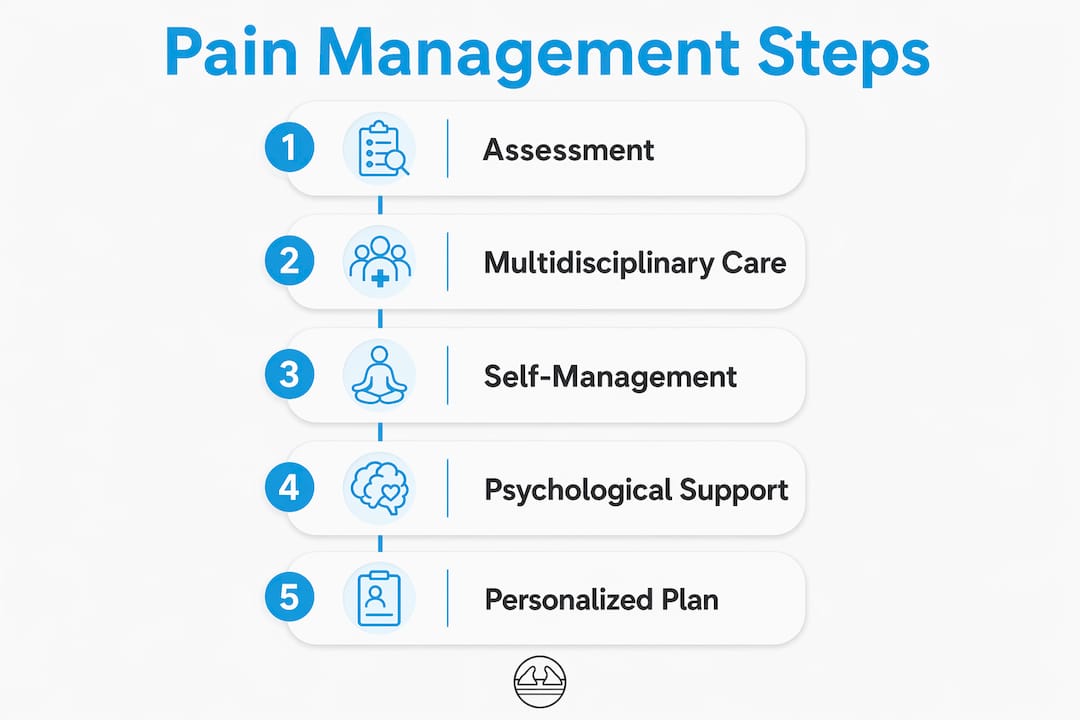
Pacing is the foundation of good self-management. It means balancing activity and rest to avoid the boom-and-bust cycle that causes flare-ups. A practical example: walking 10 minutes, 3 times per week, then gradually increasing duration as tolerance builds. This prevents both overexertion and deconditioning, two common traps for people with chronic pain.
Practical self-management strategies include:
- Pacing: Break tasks into smaller segments and rest before pain peaks, not after
- Goal setting: Set specific, time-bound targets like “walk to the mailbox daily for one week”
- Sleep hygiene: Maintain consistent sleep and wake times to reduce pain amplification from fatigue
- Nutrition: Reduce inflammatory foods and maintain hydration to support tissue recovery
- Body awareness: Track pain patterns in a journal to identify triggers and progress
Pro Tip: Consistency matters more than intensity. A 10-minute daily walk produces more lasting benefit than a 60-minute session once a week that leaves you exhausted.
Lifestyle factors like sleep and nutrition are often underestimated in pain relief planning. Poor sleep raises pain sensitivity. Chronic inflammation from diet amplifies nerve responses. Addressing these factors is not optional. They are part of the treatment.
Why does pain management require a personalized, trial-and-error approach?
Pain is subjective. Two people with identical MRI findings can experience completely different levels of disability. This is why finding the right therapy requires patient-clinician collaboration, persistence, and a willingness to adjust. There is no universal protocol that works for everyone.
Successful pain management is defined clinically as a 30%–50% reduction in pain intensity alongside improved function, not complete elimination of pain. That distinction changes everything. It means progress is measurable even when pain does not disappear entirely. It also means the goal is always functional improvement, not a pain score of zero.
A multidisciplinary team typically includes:
- A pain specialist or physiatrist to coordinate the overall plan
- A physical therapist to guide movement and rehabilitation
- A psychologist or counselor to address emotional and cognitive factors
- A nutritionist or lifestyle coach for foundational health support
- Your primary care physician to manage medications and monitor overall health
Adjustment is a normal part of the process. A therapy that works well for three months may need modification as your condition changes. Clinicians expect this. The most effective pain management techniques are the ones you and your care team refine together over time.
How do cognitive and psychological methods alter pain perception?
The brain does not simply receive pain signals. It interprets, amplifies, or suppresses them based on context, emotion, and expectation. CBT reduces disability and distress caused by chronic pain through active patient involvement, not by eliminating the pain source itself. Think of it like learning a sport: the skill builds through practice, not passive observation.
Mindfulness and CBT alter the brain’s pain processing pathways, improving wellbeing even when pain intensity stays the same. This is a critical insight. Pain can feel less disabling without becoming less intense. That shift in perception changes how much pain interferes with daily life.
The placebo effect in pain management also highlights how powerfully expectation and communication shape outcomes. Supportive, clear communication from a clinician is not just good bedside manner. It is a measurable part of treatment. Patients who understand their condition and trust their care team report better results.
| Psychological method | Primary benefit | How it works |
|---|---|---|
| Cognitive behavioral therapy | Reduces disability and distress | Restructures negative thought patterns around pain |
| Mindfulness-based stress reduction | Improves mood and sleep | Trains attention to reduce pain reactivity |
| Acceptance and commitment therapy | Increases functional engagement | Shifts focus from pain elimination to valued living |
| Expectation management | Enhances treatment outcomes | Clinician communication shapes nervous system response |
Psychological therapies work best when combined with physical approaches. The science of decompression and nervous system relief shows that physical and cognitive interventions reinforce each other. Neither works as well in isolation.
Key Takeaways
Effective pain management combines non-pharmacological therapies, pacing strategies, psychological support, and personalized clinical care to improve function and quality of life, not just reduce pain scores.
| Point | Details |
|---|---|
| Chronic pain definition | Pain lasting 3 months or longer requires a structured, multidisciplinary management plan. |
| Non-opioid first approach | 2026 clinical standards make non-pharmacological care the first line of treatment for chronic pain. |
| Success is functional, not zero pain | Clinicians define success as a 30%–50% pain reduction with improved daily function. |
| Pacing prevents flare-ups | Breaking activity into small, consistent sessions avoids overexertion and deconditioning. |
| Psychology changes pain perception | CBT and mindfulness reduce disability and distress even when pain intensity stays the same. |
What I’ve learned about pain management after years of watching people struggle with it
Most people come to pain management expecting a fix. They want the pain gone. What they get instead is a process, and that gap between expectation and reality is where a lot of people give up too soon.
The most important shift I’ve seen in effective pain care is this: the goal is not a pain score of zero. The goal is getting your life back. That means being able to walk your dog, sit through a meal, sleep through the night. When you measure progress by those markers instead of a number on a scale, the whole experience changes.
The 2026 biopsychosocial model is the right framework. Pain is not just a body problem. It is a nervous system problem, a sleep problem, a stress problem, and sometimes a meaning problem. The people who do best are the ones who engage with all of those dimensions, not just the physical ones.
Active participation matters more than any single therapy. Patients who track their symptoms, communicate openly with their care team, and experiment with self-management tools consistently outperform those who show up and wait to be fixed. You are not a passive recipient in this process. You are the most important variable.
If you are navigating chronic pain right now, I want you to know that the absence of a quick fix is not a failure. It is the nature of the condition. The right plan, built around your specific triggers and goals, makes a real difference. Give it time, stay consistent, and keep the conversation going with your clinicians.
— Cameron
Thrival’s Deep Tissue Pro as part of your recovery plan
Physical self-management tools are a practical complement to any pain management program. Thrival’s Deep Tissue Pro is a non-motorized, US-manufactured recovery system designed for targeted muscle release across the back, hips, neck, and shoulders.

The system uses a single base board with interchangeable attachments, including the Thrival Wave, Bullseye, Arch, and Ballhead, each designed to target specific muscle groups and tight spots. It is FDA-registered, built for durability, and comes with a lifetime warranty. A dedicated app and instructional routines guide you through effective muscle therapy techniques so you get consistent results at home. Free shipping is included on every order.
FAQ
What is pain management in simple terms?
Pain management is a medical specialty that uses a combination of therapies to reduce chronic or complex pain and improve daily function. It includes physical, psychological, and lifestyle-based treatments, not just medication.
How long does chronic pain last before it needs treatment?
Chronic pain is defined as pain lasting 3 months or longer. At that point, a structured pain management plan is recommended to prevent further functional decline.
Is pain management only about opioids?
No. 2026 clinical standards prioritize non-pharmacological care as the first line of treatment, with opioids limited to 3 months in selected cases. Physical therapy, CBT, and lifestyle changes are the primary tools.
Can pain management eliminate pain completely?
Complete elimination is rarely the clinical goal. Treatment success is defined as a 30%–50% reduction in pain intensity alongside meaningful improvement in function and quality of life.
What self-management strategies work best for chronic pain?
Pacing, consistent low-intensity exercise, sleep hygiene, and CBT are the most evidence-supported self-management strategies. Combining these with targeted muscle therapy produces the most durable results.