


Most athletes assume that recovery days mean parking yourself on the couch. That instinct is natural, but it’s also limiting. Active recovery, the practice of performing low-intensity movement on rest days or after hard training sessions, has strong physiological backing for reducing muscle soreness, clearing metabolic waste, and restoring your range of motion faster than complete stillness. If you train consistently, understanding active recovery is not optional; it’s a fundamental part of performing better and staying healthier longer.
Table of Contents
- Defining active recovery: More than just ‘rest’
- How active recovery works: Key mechanisms and benefits
- Active recovery methods: What really works
- When to use active versus passive recovery
- Integrating active recovery: Real-life strategies for athletes
- Why active recovery is often misunderstood—and what most guides miss
- Enhance your recovery routine with Thrival tools
- Frequently asked questions
Key Takeaways
| Point | Details |
|---|---|
| Active recovery defined | Active recovery means gentle movement after exercise to aid muscle repair and reduce soreness. |
| Science-backed benefits | It speeds healing by increasing blood flow, clearing waste, and delivering nutrients to muscle tissue. |
| Proven methods | Activities like walking, yoga, and swimming at low intensity are most effective when done regularly. |
| When to use | Use active recovery after most workouts but choose passive rest for serious fatigue or injury. |
| Personalization matters | Tailor your routine and intensity to your body’s needs for the best results. |
Defining active recovery: More than just ‘rest’
With the foundational confusion addressed, it’s essential to break down exactly what active recovery means and how it differs from simply resting.
Active recovery refers to deliberate, low-intensity physical activity performed during or after periods of intense exercise. Think easy walking after a hard run, gentle yoga the morning after a heavy lifting session, or slow swimming between race days. The effort level stays well below your training threshold, and the goal isn’t fitness gains. The goal is facilitating faster repair of the muscle tissue you’ve already worked hard to stress.
Passive recovery, by contrast, means doing nothing. Sitting, sleeping, and completely unloaded rest all fall into this category. Passive recovery has its place, but it doesn’t actively support circulation or nutrient delivery the way movement does. Understanding the reasons mobility and recovery matter helps clarify why movement, even gentle movement, is nearly always preferable to total stillness when your body isn’t seriously injured.
Here’s a quick comparison:
| Factor | Active recovery | Passive recovery |
|---|---|---|
| Movement involved | Yes, low intensity | No movement |
| Blood flow boost | Significant | Minimal |
| Metabolic waste clearance | Faster | Slower |
| Soreness reduction | Strong evidence | Moderate |
| Best use case | After moderate training | After injury or extreme fatigue |
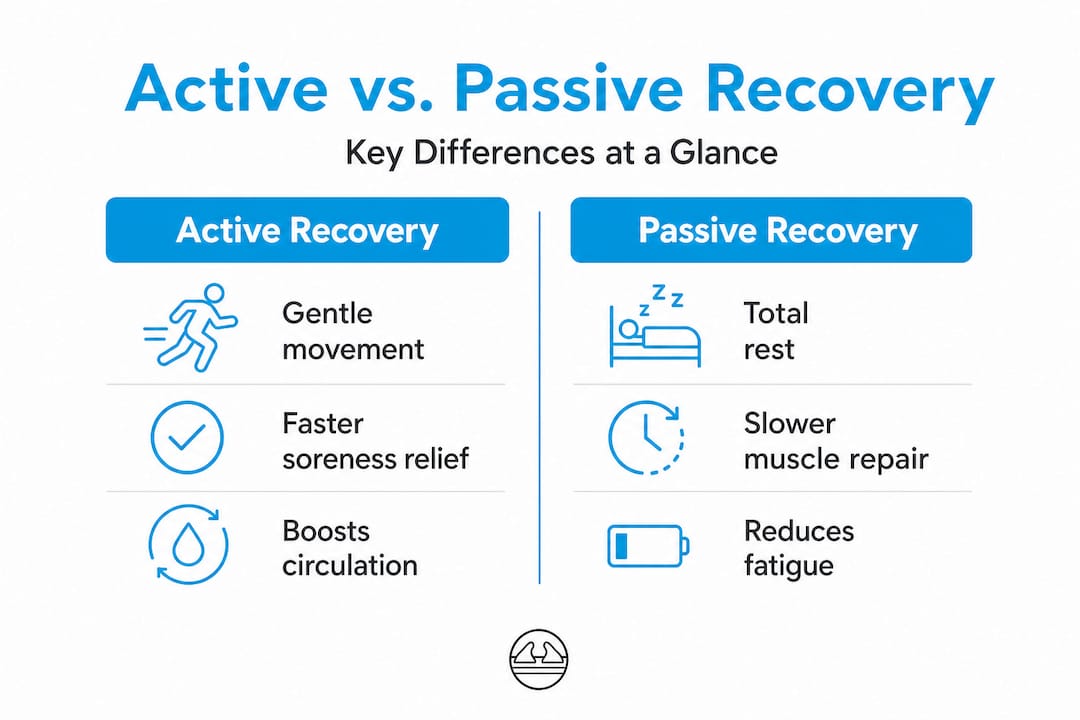
The active recovery science confirms that it promotes blood flow to deliver oxygen and nutrients to muscles, aiding repair of damaged fibers and clearance of metabolic waste like lactate. In practical terms, that means less stiffness the next morning and a body that’s primed to perform again sooner.
Key advantages of active recovery for athletes:
- Reduces next-day soreness (delayed onset muscle soreness, or DOMS)
- Supports faster return to full training capacity
- Maintains mobility and joint range of motion
- Improves circulation throughout the musculoskeletal system
- Keeps your nervous system engaged without overloading it
- Supports mental well-being by keeping you physically active
“Active recovery keeps the body moving without adding training stress, bridging the gap between hard sessions and full readiness.”
How active recovery works: Key mechanisms and benefits
Now that the concept is clear, let’s examine what makes active recovery effective for your muscles and overall performance.
When you train hard, your muscles generate metabolic byproducts. Lactate is the most commonly discussed, but hydrogen ions, carbon dioxide, and inflammatory markers all accumulate in fatigued tissue. Complete rest allows these byproducts to clear slowly. Gentle movement accelerates that process by increasing blood and lymphatic flow, flushing the tissue and resupplying it with oxygen-rich blood and essential nutrients.

The how active recovery works research shows consistent findings: low-intensity movement meaningfully accelerates lactate clearance compared to passive rest, especially in the first 30 to 60 minutes after intense training. This is exactly why professional athletes often do a short cool-down jog or easy spin after competition rather than sitting down immediately.
Beyond lactate, active recovery supports the repair of micro-damage in muscle fibers. Hard training causes tiny tears in your muscle tissue. That damage is what triggers growth and adaptation, but the repair process requires nutrients. Moving gently after a tough session keeps nutrient-rich blood circulating to those damaged fibers, which speeds healing and reduces the inflammation-related pain you feel the next day.
| Physiological effect | Mechanism | Outcome |
|---|---|---|
| Lactate clearance | Increased blood flow | Reduced soreness sooner |
| Nutrient delivery | Enhanced circulation | Faster muscle fiber repair |
| Inflammation reduction | Lymphatic drainage | Less swelling and stiffness |
| Flexibility restoration | Dynamic movement | Improved range of motion |
| Nervous system recovery | Low-load stimulation | Readiness for next session |
Good muscle recovery tools can amplify these effects by targeting specific tight spots and supporting relieving muscle tension in areas that movement alone doesn’t fully reach. Deep tissue work on the hips, lower back, or shoulders can further stimulate circulation and break up adhesions that limit mobility.
Pro Tip: Do your active recovery session within 1 to 2 hours after your primary workout for maximum lactate clearance. A 20-minute easy walk or gentle bike ride during this window outperforms the same activity done the following morning.
Key stat: Studies consistently report that athletes who perform active recovery after high-intensity training show significantly faster return to baseline soreness levels compared to athletes who rest completely.
Active recovery methods: What really works
Understanding the “how” sets the stage for practical application. Here are the types of active recovery you can implement starting today and how to execute them effectively.
The most effective active recovery activities share one trait: they get blood moving without taxing your muscles or joints beyond their current recovery capacity. Active recovery routines across the research literature consistently point to these core methods: walking, light cycling, swimming, yoga, or stretching for 20 to 45 minutes at under 60% of your max heart rate or at a conversational pace.
Proven active recovery methods:
- Walking: The most accessible option. A 20 to 30-minute walk at a comfortable pace keeps blood flowing without any joint-loading stress. Ideal after leg days or long runs.
- Gentle cycling: Stationary or outdoor, easy cycling offers low-impact leg movement with minimal eccentric muscle loading. Great for runners and weightlifters alike.
- Swimming: The buoyancy of water reduces joint stress dramatically, making swimming ideal for full-body active recovery, especially after contact sports or high-impact training.
- Yoga: Combines gentle movement, breath work, and static stretching to promote relaxation, circulation, and flexibility simultaneously.
- Dynamic stretching: Controlled, smooth joint movements like leg swings, arm circles, and hip rotations that improve range of motion without demanding intense muscle effort.
- Light foam rolling and soft tissue therapy for recovery: Manual pressure on tight spots drives blood flow locally and addresses adhesions in the connective tissue surrounding muscles.
Simple step-by-step active recovery session outline:
- Start with 5 minutes of easy walking or slow movement to gradually raise your heart rate.
- Spend 10 to 15 minutes on your chosen low-intensity activity at a comfortable, conversational pace.
- Add 10 minutes of dynamic stretching or light yoga targeting areas that felt tightest after your last workout.
- Finish with 5 minutes of deep breathing or seated stretching to bring your heart rate back down fully.
- Optional: Add deep tissue massage benefits using a targeted massage tool on specific sore muscles for an additional 5 to 10 minutes.
Pro Tip: Match your active recovery method to your sport. Cyclists recover well with swimming or walking. Runners benefit from easy cycling. Weightlifters often find yoga or gentle swimming most effective because it addresses joint mobility without reloading the same movement patterns used in training.
When to use active versus passive recovery
It’s vital to know when active recovery will help the most and when dialing back for more complete rest is the wiser choice.
Active recovery is not always the right answer. Applying it in the wrong circumstances, like using gentle movement when your body genuinely needs total rest, can extend injury timelines or mask early warning signs of overtraining. Knowing the difference is a skill that separates smart athletes from those who constantly deal with nagging injuries.
| Situation | Best recovery approach |
|---|---|
| After moderate to hard training session | Active recovery |
| Acute injury or pain | Passive rest, medical attention |
| Extreme fatigue or overtraining symptoms | Passive recovery, reduced volume |
| Between competition rounds | Active recovery (light movement) |
| Post-surgery or post-injury rehabilitation | Guided by medical professional |
| Delayed onset muscle soreness (DOMS) peak | Light active recovery or passive |
| Chronic low-grade soreness | Active recovery plus targeted soft tissue work |
The active vs passive recovery research makes an important distinction: while active recovery generally outperforms passive rest for lactate clearance and soreness after normal training sessions, passive methods or cold water immersion (CWI) outperform active approaches in cases of extreme fatigue, significant muscle damage, or during recovery from pitching-intensive sports activities.
Signals that passive recovery is the right call:
- Sharp or localized pain in a joint or muscle belly
- Swelling or bruising around a specific area
- Fatigue so deep that even walking feels like effort
- Heart rate variability (HRV) scores significantly lower than baseline
- Three or more consecutive days of poor sleep quality
“Monitoring fatigue markers and mixing strategies during the week gives athletes far more control over performance outcomes than committing to just one recovery approach.”
The soft tissue release benefits are well-documented for bridging these two approaches; targeted manual therapy can stimulate circulation without the cardiovascular demand of movement-based active recovery, making it a useful middle-ground option.
Integrating active recovery: Real-life strategies for athletes
To help you put all this knowledge into practice, here’s how real athletes and trainers successfully schedule and adapt their recovery approach week to week.
The biggest mistake most athletes make is treating recovery as an afterthought. You plan your training sessions meticulously but schedule your recovery as “whatever happens.” That approach erodes adaptation over time. Periodizing recovery alongside your training, meaning actively planning when to use active recovery, passive rest, and targeted soft tissue work, is what separates consistent performers from injured, frustrated athletes.
The expert strategies for mixing active and passive recovery guidance is clear: monitor heart rate and effort during recovery sessions because sessions that drift too intense become fatiguing, not restorative. Combine this with periodization by practicing active recovery most days and allowing one to two days of true passive rest per week.
Sample weekly recovery schedule for a training athlete:
- Monday (hard training day): Full workout, followed by 20-minute easy walk or cool-down jog.
- Tuesday (active recovery day): 30-minute light cycling or yoga session; add targeted trigger point work on the previous day’s sore muscles.
- Wednesday (moderate training day): Full workout, followed by dynamic stretching routine.
- Thursday (active recovery day): 30-minute swim or gentle yoga; foam rolling focus on hips, back, and shoulders.
- Friday (hard training day): Full workout; post-session easy walking and deep tissue massage tool use.
- Saturday (moderate training or light practice): Light active recovery session immediately after, 20 to 25 minutes.
- Sunday (passive rest day): Complete rest, quality sleep, nutrition focus.
Consistency matters more than perfection here. Even a 15-minute easy walk on what would otherwise be a complete rest day delivers measurable recovery benefits compared to pure inactivity.
Pro Tip: Avoid the common trap of making your “active recovery” sessions gradually more intense over time. Many athletes unconsciously push harder during recovery workouts because they feel good. If you finish an active recovery session feeling like you trained, it wasn’t recovery. Check your releasing trigger points practices and incorporate manual therapy to address tension without adding cardiovascular or muscular load.
Common mistakes to correct immediately:
- Going above 60% max heart rate during recovery sessions
- Skipping active recovery after your hardest training days (when it’s most valuable)
- Applying the same recovery strategy regardless of training volume or intensity
- Ignoring objective fatigue data like HRV and resting heart rate
- Treating active recovery as optional instead of scheduled and non-negotiable
Why active recovery is often misunderstood—and what most guides miss
Most articles on active recovery give you a list of activities and a heart rate range. That’s useful, but it skips the most important insight: the effort quality matters more than the specific activity you choose.
The real source of confusion is that athletes and even coaches conflate “low intensity” with “low effort.” You can perform yoga at an effort level that’s genuinely restorative or at one that’s actually demanding if you’re holding difficult poses with muscle tension throughout. A walk at a forced pace with clenched jaw and elevated shoulders isn’t recovery, regardless of how low your heart rate reads.
What years of working with athletes at every level reveals is that the best active recovery sessions share a quality of ease. The athlete finishes feeling more relaxed and mobile than when they started. If you finish your recovery walk feeling like you powered through something, you did it wrong.
Most guides also miss the personalization dimension entirely. A 45-minute swim might be perfect active recovery for a powerlifter but borderline training stress for a competitive swimmer. A light jog is genuinely easy for a marathon runner but could be moderate effort for someone who primarily lifts. Recovery needs to be calibrated to you, your current fitness, your sport’s demands, and where you are in your training cycle.
The importance of recovery is not debatable. What is debatable is how rigidly you apply any single framework. Smart recovery means observing your body’s daily signals, adjusting your approach accordingly, and treating recovery as a skill that requires the same intentionality you bring to your hardest workouts.
One more thing most guides miss: active recovery is not just physical. The gentle movement, the focused breathing, the deliberate ease of a recovery session all have measurable effects on the nervous system. Athletes who treat recovery sessions as a mental reset alongside a physical one consistently report better performance and lower injury rates.
Enhance your recovery routine with Thrival tools
Having learned the science and art of active recovery, see how the right tools can elevate your routine even further.
Active recovery sessions become significantly more effective when you pair movement with targeted muscle release. That’s where Thrival’s muscle recovery solutions make a real difference. Thrival’s US-made deep tissue tools are designed to address tight spots in the back, hips, neck, and shoulders with precision that general movement can’t replicate.
The Thrival Deep Tissue Pro delivers professional-grade muscle relief you can use at home or on the road, right after your active recovery session. Pair it with specialized Thrival Wave attachments to target specific areas and extend the circulation benefits your active recovery work started. Every tool ships free with a lifetime warranty and FDA registration for confidence in quality and safety.
Frequently asked questions
What is the main difference between active and passive recovery?
Active recovery means engaging in gentle movement, while passive recovery involves complete rest without activity. Research on active and passive recovery shows that active approaches generally outperform passive rest for clearing metabolic waste and reducing soreness after normal training sessions.
How often should I do active recovery?
Most athletes benefit from active recovery on the majority of training days, with one to two days per week set aside for passive strategies. Expert recovery periodization recommends monitoring heart rate and effort to prevent recovery sessions from drifting into additional training stress.
What are the best activities for active recovery?
Walking, gentle cycling, swimming, yoga, and stretching are all highly effective options. Evidence-based active recovery guidelines recommend performing these activities for 20 to 45 minutes at under 60% of your max heart rate.
How intense should active recovery be?
Keep effort light, generally under 60% of max heart rate or at a pace where you can hold a full conversation comfortably. If you’re breathing hard or feel like you’re training, the intensity is too high for recovery purposes.
Can I use active recovery after every workout?
Yes, low-intensity active recovery is beneficial after most workouts and supports ongoing mobility maintenance. The key is keeping it genuinely easy; periodizing your recovery ensures you don’t accumulate fatigue from sessions that are too intense to truly restore your body.